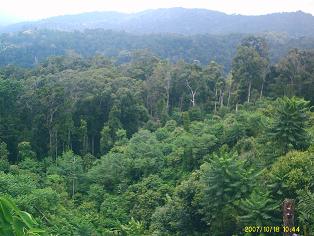
| Indonesia’s biodiversity richness is made possible by several factors: it is located between two continents (Asia and Australia) and two oceans (Pacific and Indian) and it has a unique geographical feature (State Ministry of Environment, 1997). Indonesia is an archipelago of more than 17,000 islands extending 5,000 km along the equator and spanning two major biogeographical realms (Indomalaya and Australasia) with the Wallace Line in between, as well as several distinct biogeographical provinces. As a result, Indonesia is not only a megabiodiversity country but also has a high level of endemism.Many of Indonesia's forests include in Tropical Rain Forest is a complex community whose framework is provided by trees of many sizes. Forest canopy is used as a general one to describe the total plant community above the ground. Within the canopy the microclimate differs from that. outside; there is less light, humidity is higher, and temperature is lower. Many of the smaller trees grow in the shade of the larger ones in the microclimate that these produce. Upon the framework of the tree and within the microclimate of the canopy grow a range of other kinds of plants: climbers, epiphytes, strangling, plants parasites, and saprophytes. The trees and most of the other plants are rooted in the soil and draw nutrients and water from it. Their fallen leaves, twigs, branches, and other parts provide ; food for a host of invertebrate animals, amongst which termites are often important, and for fungi and bacteria. Nutrients are returned to the soil via decay of fallen parts and by leaching from the leaves by rain-water. It is a feature of tropical rain forest that most of the total nutrient store is in the vegetation; relatively little is held in the soil (Withmore, 1975). |